

Accessing a loved one’s finances doesn’t always require a long battle in probate court, but the wrong first step can freeze an account for months. Many families in the Upstate believe they must wait for a full court process to begin, but the reality is that closing bank accounts after death follows a specific legal sequence that often offers shortcuts. It's natural to feel overwhelmed by the fear of doing it wrong or the frustration of being told "no" by a teller. You deserve a clear path that respects your grief while handling the logistics with efficiency.
We understand that this is a high-stress period and you need reliable answers. This guide simplifies the South Carolina probate system, showing you exactly how to claim funds while avoiding unnecessary delays. You'll learn about the updated $45,000 small estate threshold, the specific documents South Carolina banks require, and how to distinguish between assets that must go through court and those that pass directly to you. We've organized these steps to help you move forward with confidence, dignity, and steady composure.
Key Takeaways
- Understand why banks freeze assets immediately and why closing bank accounts after death requires a formal legal sequence rather than simple PIN access.
- Differentiate between probate assets and joint accounts with right of survivorship to determine which funds transfer automatically to survivors.
- Learn how to utilize the South Carolina Small Estate Affidavit to settle accounts efficiently if the total estate value is under $45,000.
- Follow a clear checklist for gathering required documentation, including certified death certificates, to ensure a smooth interaction with Upstate financial institutions.
- Discover how pre-planning final arrangements can reduce the immediate administrative burden and logistical stress for your family during a loss.
The Legal Reality of Closing Bank Accounts After Death
When a family member passes away, the transition of their financial life is rarely as simple as a single phone call. The process of closing bank accounts after death is a structured legal sequence designed to protect the assets of the deceased. While it may feel like an added burden during a time of grief, these safeguards exist to ensure that funds reach the correct beneficiaries and that all final obligations are met. The Legal Reality of Closing Bank Accounts is rooted in the South Carolina Probate Code, which dictates exactly who has the authority to move money and when they can do it. Understanding these rules early can prevent unnecessary delays and legal complications.
Why Accounts are Frozen
The moment a financial institution is notified of a death, they typically place an immediate hold on all accounts held solely by the deceased. This is not meant to be a hurdle for the family. Instead, it's a fulfillment of the bank's fiduciary duty. Account freezing is a protective measure that halts all transactions until a legal representative is verified by the court. Banks often learn of a death through the Social Security Administration’s reporting system, though they may also act on a direct report from a family member or a funeral home. This freeze prevents unauthorized withdrawals, stops automated payments that are no longer valid, and secures the estate for the eventual heirs.
There is a common "Access Myth" that often leads to trouble for Upstate families. Many believe that if they have a loved one’s debit card and PIN, they can simply withdraw funds to pay for immediate needs like flowers or travel. This is legally problematic. Using a PIN after a person has died is technically unauthorized access. It can result in personal liability for the individual, even if the money was used for legitimate family expenses. It's always better to wait for the proper legal authority to avoid being questioned by the Probate Court or other beneficiaries later.
Legal Authority and the Probate Court
In South Carolina, the authority to manage a deceased person's bank account doesn't come from a family relationship alone. It comes from the Probate Court. Whether you're working with a bank in Greenville, Spartanburg, or Anderson, they will require specific court-issued documents. These are generally referred to as "Letters Testamentary" if the deceased had a will, or "Letters of Administration" if they did not. These documents officially appoint a Personal Representative, also known as an executor, to handle the estate’s finances.
The South Carolina Probate Code offers two paths to start this process: informal and formal. Most families can utilize the informal probate process, which is quicker and involves less court interaction. However, if there are disputes among heirs or complexities with the will, a formal probate filing may be necessary. This legal standing is the only way a bank will permit the closing bank accounts after death for assets held in the decedent's name alone. By following these established steps, you protect the estate and ensure a transparent, dignified settlement process.
Account Types and Their Impact on Closure Procedures
The speed and simplicity of closing bank accounts after death depend entirely on how the account was originally titled. While some accounts require a lengthy court process, others transfer to heirs in a matter of days. South Carolina law provides several paths for these transfers, and understanding which one applies to your situation can save weeks of administrative frustration. Account Types and Their Impact on Closure Procedures are governed by specific state statutes that prioritize clear ownership and designated beneficiaries.
Joint Accounts vs. Single Ownership
In the Upstate, most joint accounts are held with the "Right of Survivorship." This means that when one owner passes away, the surviving owner automatically becomes the sole owner of the funds. The money does not become part of the probate estate. To update the account, the survivor typically only needs to present a certified death certificate to the bank. However, families should watch for "convenience accounts." These occur when a name was added solely to help an elderly parent pay bills, without the intent of transferring ownership. If a bank determines an account was for convenience only, the funds may still be subject to probate. Removing a deceased person's name from a true joint account is a straightforward way to maintain financial stability during a high-stress period.
The Power of POD Beneficiaries
A Payable-on-Death (POD) designation is one of the most efficient tools for closing bank accounts after death without court intervention. This is considered a non-probate transfer. If your loved one named a POD beneficiary, that individual can claim the funds by visiting a branch in Anderson or Spartanburg with their government-issued ID and a death certificate. The bank doesn't need to wait for a Personal Representative to be appointed. Disbursement usually happens quickly once the paperwork is verified. Transfer-on-Death (TOD) designations work similarly for brokerage accounts, ensuring that stocks and bonds move directly to the intended recipient.
Trust accounts offer the highest level of privacy and speed. Because a trust is its own legal entity, it doesn't "die" when the individual does. The successor trustee simply steps in and follows the trust's instructions. This bypasses the probate court entirely, keeping financial details private and accessible. Planning for these administrative hurdles in advance is a profound form of care for your family. Many families find that exploring personalized services that address both physical and logistical needs provides a sense of tranquility and order during a difficult season.
Navigating South Carolina Small Estate Affidavits
For many families in the Upstate, the formal probate process feels like a daunting obstacle. However, South Carolina law provides a streamlined shortcut for smaller estates that significantly simplifies closing bank accounts after death. This process utilizes the "Affidavit for Collection of Personal Property," commonly known as a Small Estate Affidavit. As of May 8, 2025, the threshold for this simplified procedure increased from $25,000 to $45,000. This change allows more local families to settle financial affairs without the time and expense of a full probate administration, providing a much-needed sense of relief during a high-stress period.
Qualifying for a Small Estate Affidavit
To use this shortcut in Greenville or Seneca, the estate must meet strict criteria. The total value of the decedent's personal property, including bank accounts and vehicles, must not exceed the $45,000 limit. You must also wait for a mandatory 30-day period to pass after the date of death before filing. It's important to understand that real estate ownership often disqualifies "small estate" status because the affidavit only applies to personal property, not land or homes. If your loved one owned a home in their name alone, you'll likely need to follow the full probate path regardless of the bank account balance. The Probate Court must approve the affidavit before any financial institution will recognize your authority.
Filing the Paperwork in the Upstate
Filing the paperwork requires a visit to your local probate office, such as the Greenville County Probate Court. You'll need to submit the completed Form 420ES along with a certified copy of the death certificate. There are filing fees associated with this process, which follow a graduated scale based on the estate's value. For example, estates valued between $20,000 and $45,000 currently carry a filing fee of $67.50. Once the probate court approves and stamps the affidavit, it carries the weight of law.
When you present this validated document to a bank, they are legally required to respond by releasing the funds to the person named in the affidavit. This legal mandate ensures that the process of closing bank accounts after death remains efficient and transparent. By using this method, you avoid the 8-month creditor claim period required in formal probate, allowing for a faster transfer of funds to beneficiaries. This structural simplicity mirrors the modern need for efficiency while respecting the gravity of your loss. It's a pragmatic solution designed to provide a guiding hand to families when they need it most.
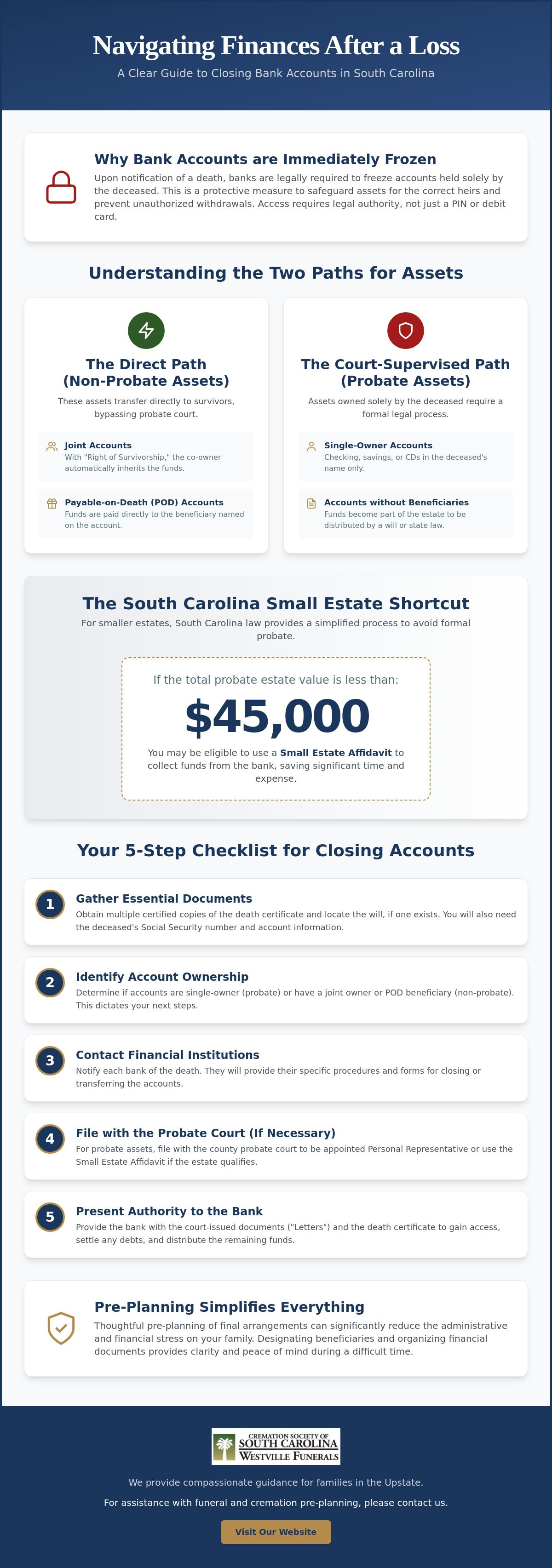
A Step-by-Step Checklist for Closing Accounts in SC
Moving from the legal requirements of the probate court to the actual lobby of a bank requires a clear plan. While the emotional weight of loss is heavy, having a logical checklist allows you to handle the logistics with steady composure. The process of closing bank accounts after death is most efficient when you arrive prepared, preventing multiple trips and bureaucratic friction. This sequence ensures that you protect the deceased’s legacy while fulfilling your duties as a survivor or representative.
- Step 1: Order Certified Death Certificates. You'll need multiple copies with the official raised seal. South Carolina banks rarely accept simple photocopies for these transactions.
- Step 2: Inventory Every Account. Look for checking, savings, CDs, and safe deposit boxes. Don't forget local credit unions or online-only banks.
- Step 3: Establish Legal Authority. Bring your court-issued Letters Testamentary or, if you're a POD beneficiary, your government-issued ID.
- Step 4: Prepare the "Survivor’s Kit." Gather all documents into a single folder to ensure you have everything the teller or manager might request.
- Step 5: Finalize Disbursement. Decide if the funds will move into a newly created estate account or be issued as a check to the designated beneficiaries.
Gathering Your Documentation
Banks in the Upstate have strict security protocols to prevent identity theft and fraud. You must provide a certified death certificate because it serves as the primary legal proof of death. If you're opening an estate account to manage the decedent’s bills, you'll also need a Tax ID Number (EIN) from the IRS. This is a simple process that can be completed on the IRS website; it acts like a Social Security number for the estate. Always bring your own valid, government-issued photo ID. The bank needs to verify your identity as the person authorized to handle the closing bank accounts after death.
Managing Automatic Payments and Debts
One of the most frustrating aspects of financial settlement is dealing with "zombie" subscriptions and recurring ACH transfers. Once a bank freezes an account, most automated payments will fail. However, you should still contact utility companies, insurance providers, and streaming services to stop billing immediately. Be aware of outstanding checks written before the death. These may still clear if the bank hasn't been notified. Additionally, understand the bank’s right to "set-off." If the deceased owed the bank money, such as for a credit card or loan, the institution may legally use funds from the checking account to pay those debts before releasing the balance to the estate.
Taking these steps ensures that the financial transition is as smooth as possible. If you need help coordinating these logistics alongside final arrangements, we invite you to explore our personalized services and live-streaming options. We're here to provide the stewardship and support your family needs during this time.
How Pre-Planning Simplifies Financial Logistics
The stress of closing bank accounts after death is often compounded by the immediate need for funds to cover final arrangements. When accounts are frozen, families are frequently forced to look for alternative resources while waiting for the probate court to grant access. Pre-planning changes this dynamic. It shifts the burden from a crisis intervention to a prepared solution. By making these decisions now, you ensure your family has a clear roadmap rather than a logistical puzzle. This proactive approach provides tranquility, dignity, and a sense of order during a high-stress period.
The Gift of a Pre-Arranged Plan
A pre-arranged plan acts as a problem-solution framework for your estate. One of the most effective ways to simplify future logistics is through simple cremation services. These plans can be funded in advance through specialized funeral trusts or insurance policies that pay directly to the provider. This arrangement bypasses the probate process entirely. It means your family doesn't have to worry about finding liquid cash while bank accounts are locked. Additionally, consolidated planning reduces the number of certified death certificates your family needs to order, as many administrative steps are finalized before the need arises.
Support for Upstate Families
Cremation Society of South Carolina - Westville Funerals is committed to providing steady composure and guidance to families in Greenville and Seneca. Our role extends beyond the service itself. We assist with the professional handling and legal processing of requirements that banks demand. This includes the timely filing and procurement of death certificates. We understand the gravity of loss and the efficiency required to handle logistics without unnecessary bureaucracy. Organizing "The Folder" with your financial details now is a profound form of care for your survivors.
Our team serves as a supportive ally. We respect your family's needs while maintaining the pragmatic focus required for estate settlement. We offer modern tools and traditional values to make this process affordable and accessible. Contact Cremation Society of South Carolina - Westville Funerals for immediate assistance or pre-planning guidance to ensure your family is supported with dignity and transparency. We're here to help you prepare today for a more peaceful tomorrow.
Moving Forward with Clarity and Peace
Settling an estate is a journey that requires both patience and the right information. By understanding the $45,000 small estate threshold and the specific requirements of Upstate financial institutions, you can handle the process of closing bank accounts after death with confidence. These steps protect your loved one's legacy while ensuring that funds reach the right hands without unnecessary court delays. Clarity regarding these logistics is a form of compassion for yourself and your heirs.
We are a locally owned and operated business committed to the families of the Upstate. Our team provides 24/7 compassionate support for Greenville, Seneca, and Spartanburg. We specialize in affordable, eco-friendly options such as aquamation south carolina, ensuring that every family has access to innovative and dignified care. We serve as your reliable community partner, helping you navigate every administrative and emotional requirement with steady composure.
Plan for peace of mind—explore our pre-planning options today. You don't have to face these complex logistics alone. Taking small, proactive steps today provides lasting comfort and financial security for those you love tomorrow.
Frequently Asked Questions
Can I close a bank account with just a death certificate?
No, a death certificate alone is rarely enough to close a solely owned account. While the certificate proves the death, it doesn't prove you have the legal authority to handle the money. You'll also need court-issued Letters Testamentary or a Small Estate Affidavit. However, if you are a named beneficiary or a joint owner with right of survivorship, the bank only needs the certificate and your photo ID.
How long does it take to close a bank account after someone dies in South Carolina?
The timeline depends on the account's legal structure. Joint accounts and those with beneficiaries can often be settled in a single bank visit. If you're using a Small Estate Affidavit, you must wait at least 30 days after the death before you can file the paperwork. Formal probate typically takes much longer, often lasting between 6 and 18 months depending on the estate's complexity.
What happens to a bank account if there is no will?
If there is no will, the estate is considered "intestate." The Probate Court will appoint a Personal Representative based on South Carolina’s priority list, usually starting with a surviving spouse or children. This representative is responsible for closing bank accounts after death and eventually distributing the funds to the heirs-at-law defined by state statute after all debts are paid.
Can a bank account be closed without probate in SC?
Yes, many accounts bypass the probate process entirely. Accounts with "Payable on Death" (POD) beneficiaries or joint accounts with right of survivorship transfer automatically to the survivor. For accounts that don't have these designations, you can still avoid formal probate if the total estate value is under $45,000 by using the Small Estate Affidavit process through your local Upstate probate office.
Who is responsible for paying the deceased person’s debts from the bank account?
The court-appointed Personal Representative is responsible for using the estate's funds to pay valid debts and taxes. It's important to remember that heirs are generally not personally liable for a loved one's debts unless they co-signed on a loan. Banks may also exercise a "set-off" right, where they use funds in a checking account to pay off the deceased person’s credit card or loan at that same bank.
Is a Power of Attorney still valid after someone passes away?
No, Power of Attorney authority ends instantly at the moment of death. Any attempt to use a POA to access or move funds after a person has died is legally invalid and can lead to serious repercussions. Once a death occurs, legal authority shifts to the court-appointed representative, a successor trustee, or the named beneficiaries on the account.
How many copies of the death certificate will the bank need?
You should plan to provide one certified copy for each financial institution where the deceased held accounts. While some bank managers in Greenville or Spartanburg may scan the document and return the original to you, many institutions require a certified copy for their permanent legal records. Ordering five to ten certified copies is a standard practice for most local families to ensure they have enough for all administrative needs.

Article by
Ian Nelms
Ian Nelms has worked in the funeral and cemetery profession since 1991, beginning his career in Beaumont, Texas. Over the past three decades, he has been involved in all aspects of the death care industry—including operations, acquisitions, preneed development, crematory management, and the leadership of multi-location funeral home and cemetery organizations.
His experience across a wide range of service models provides a practical understanding of the decisions individuals and families face, along with the importance of clarity, simplicity, and value. His work today is focused on industry strategy, operational development, and improving how funeral service providers communicate and deliver options in a modern environment.
In addition to his work in funeral service, Ian is actively engaged in technology, marketing, and artificial intelligence. He applies AI systems, prompt engineering, and digital strategy to enhance how information is shared, how services are presented, and how organizations better serve their communities. He is also the founder of Memorial Flight Systems, a drone operations company focused on aerial services and emerging applications.
Earlier in his career, Ian navigated a legal matter related to a business transaction that was resolved. That experience shaped his commitment to accountability, transparency, and disciplined operations. Since then, he has continued to build, advise, and operate businesses with a focus on long-term trust and performance.
He writes to provide practical, straightforward insight for readers seeking clear information about funeral service and end-of-life options across Greenville, Spartanburg, Anderson, and the surrounding areas of Upstate South Carolina.
Disclaimer
Content provided by Ian Nelms is for informational and educational purposes only and does not constitute funeral directing, arrangement services, or licensed preneed advice. Laws and regulations vary by state; for assistance, please contact Cremation Society of SC–Westville Funerals or a licensed funeral professional in your area for more information.