

Imagine discovering that bringing a loved one back home requires more complex coordination than an international relocation. It's a startling reality for many families during a time of deep loss. Most people feel an immediate sense of anxiety when they start researching the logistics of transporting human remains out of state. You want to honor your loved one's final wishes, but the maze of TSA regulations, airline protocols, and conflicting state laws can feel insurmountable. It's a heavy burden to carry when you should be focused on remembrance and healing.
We understand the pressure you're under. This guide provides the steady, professional hand you need to navigate the legal and logistical requirements of moving a loved one across state lines. You will find a clear path forward through the confusion of permits and paperwork. We'll provide a straightforward checklist of required South Carolina documents, explain the practical differences between air and ground transport, and help you find a reliable local partner to manage the logistics. Our goal is to provide the transparency and composure you need to bring your loved one home with dignity and ease.
Key Takeaways
- Identify the essential legal documents required for South Carolina transfers, including the Burial-Transit Permit and specific DHEC regulations.
- Learn how to manage the complex logistics of transporting human remains out of state by distinguishing between "ship-out" and "ship-in" service requirements.
- Determine the most cost-effective travel method by comparing ground transport for distances under 500 miles against specialized airline requirements.
- Avoid unexpected financial burdens by understanding how "forwarding" and "receiving" fees appear on a funeral home’s General Price List.
- Discover how expert coordination and immediate assistance can simplify the professional hand-off between two funeral providers in different states.
Understanding the Logistics of Transporting Human Remains
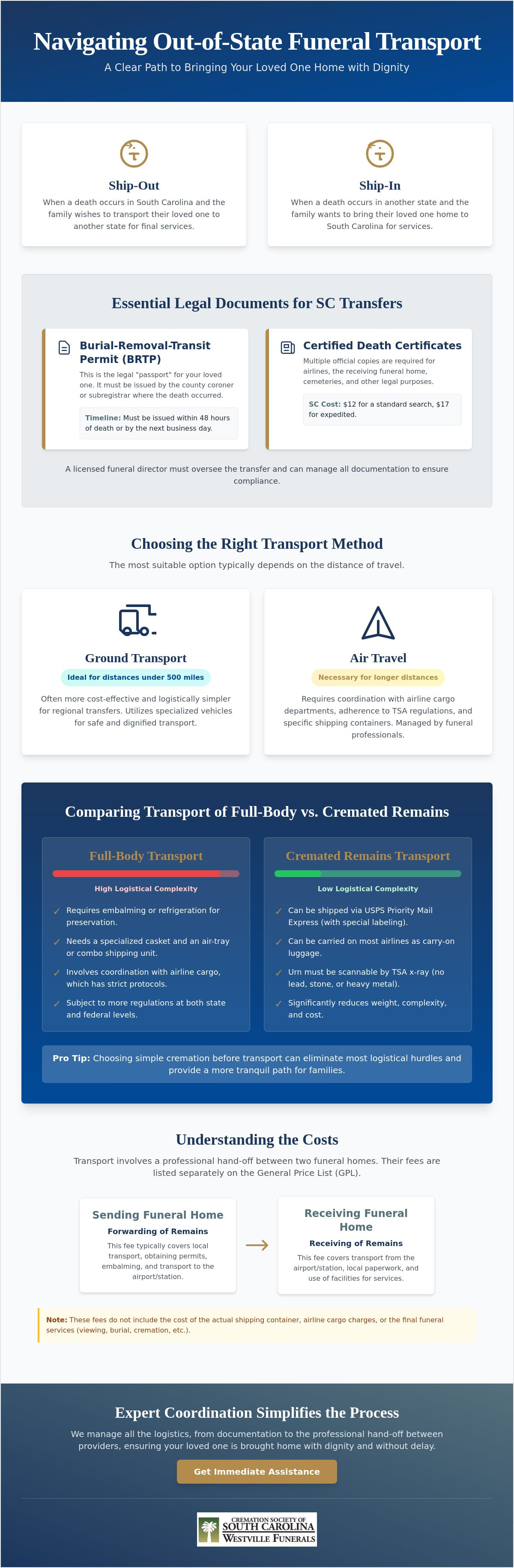
Transporting human remains out of state is the professional process of moving a deceased person across state lines for final disposition. This isn't a simple shipping task. It is a highly regulated coordination between two funeral homes. In the industry, we distinguish between two primary directions. A "Ship-out" occurs when a death happens in South Carolina and the family wishes to send their loved one elsewhere. A "Ship-in" is the opposite. This happens when a loved one passes away in another state and you want to bring them home to Greenville or Seneca for services.
Most airlines and state agencies require a licensed funeral director to oversee the transfer. You cannot simply transport a body in a personal vehicle across most state lines without specific permits. The receiving funeral home plays a vital role here. They prepare for the arrival, handle the local permits, and ensure the facilities are ready for the final service. This coordination mirrors the standards found in international agreements on the transfer of remains, ensuring dignity and safety throughout the journey.
- Ship-out: Moving a loved one from South Carolina to another state.
- Ship-in: Bringing a loved one to the Upstate from elsewhere.
- Professional Hand-off: The coordinated exchange between the sending and receiving funeral providers.
When is Out-of-State Transport Necessary?
Families often face this challenge when transporting human remains out of state after a death occurs unexpectedly during travel or a temporary relocation. It's also common when a family has a long-standing plot in another state. Sometimes, families seek out-of-state transport to access modern options not available in the state where the death occurred. For instance, families may choose to bring a loved one to us specifically for aquamation south carolina. This eco-friendly water cremation method is a gentle alternative to traditional fire cremation, and it is fully legal and available here in the Upstate.
The Difference Between Full-Body and Cremated Remains Transport
The logistics change significantly depending on whether you are moving a body or ashes. Transporting cremated remains is much simpler. You can ship them via USPS Priority Mail Express or carry them on a plane, provided you follow TSA container rules. Full-body transport is far more complex. It requires specialized containers, embalming or dry ice, and coordination with airline cargo departments. Choosing simple cremation services before the transfer can remove much of this logistical friction. It reduces the weight and eliminates the need for heavy caskets or specialized flight trays during the journey. This approach often provides a more tranquil path for families who are already overwhelmed by the details of a loss.
Legal Requirements and South Carolina Transfer Permits
When you are transporting human remains out of state, the paperwork is as critical as the physical movement. South Carolina law is specific about how a body leaves our borders. The primary document you need is the Burial-Removal-Transit Permit (BRTP). This acts as a legal passport for your loved one. According to the South Carolina Burial-Removal-Transit Permit regulations, this permit must be issued within 48 hours of the death or by the next business day. A funeral director typically handles this request through the county coroner or subregistrar where the death occurred.
You will also need multiple certified copies of the death certificate. In South Carolina, a standard search costs $12, while an expedited search is $17. Airlines, receiving funeral homes, and cemeteries all require their own official copies. This isn't just bureaucracy. It's a vital chain of custody. It ensures the identity and safety of the deceased are protected at every step. If you feel overwhelmed by these administrative hurdles, our team can manage the documentation for you to ensure every legal requirement is met without delay.
Embalming is another factor to consider. South Carolina law doesn't strictly require embalming unless there's a public viewing. However, common carriers like airlines or the laws in the receiving state often mandate it. If you prefer to avoid chemical preservation, you must coordinate with the transport provider to see if dry ice or specialized "Ziegler cases" are acceptable alternatives. We help you navigate these conflicting rules to find the most respectful solution.
The Role of SC DHEC in Human Remains Transport
South Carolina DHEC monitors the movement of remains to maintain accurate public health records. This tracking is mandatory whether your loved one is crossing the border by plane or by car. If you're moving a body for a traditional ground burial in Greenville or Spartanburg, the BRTP must accompany the remains at all times. It's the legal proof that the death was properly registered and the transport is authorized. You cannot legally cross state lines with remains in a private vehicle without this specific permit in your possession.
Federal and TSA 'Known Shipper' Regulations
Security is tight for air travel. Funeral homes must be registered in the TSA "Known Shipper" program to book remains on a commercial flight. Families cannot personally arrange this transport with an airline. Every casket or air-transit container undergoes a specific screening process. This ensures the cargo area of the aircraft remains secure while maintaining the highest level of respect for the individual being moved. We handle these federal interactions so you don't have to manage the complexities of airline security alone.
Choosing Between Ground Transport and Air Travel
Deciding on a travel method for transporting human remains out of state involves balancing speed, cost, and emotional comfort. For many families in the Upstate, the total distance is the deciding factor. Ground transport is usually the most cost-effective and straightforward option for distances under 300 to 500 miles. If you are moving a loved one from regional hubs like Charlotte, Asheville, or Atlanta back to Greenville, a specialized vehicle is often the better choice. This method avoids the complexities of airport cargo terminals and the need for expensive, airline-mandated shipping containers.
When transporting human remains out of state over longer distances, air travel becomes the standard. This requires strict adherence to NFDA guidelines on shipping human remains. Our team coordinates directly with cargo departments at major carriers like Delta or American Airlines to ensure a dignified journey. While air travel is faster for cross-country moves, it is subject to weather delays and flight cancellations. We monitor these schedules closely to prevent disruptions to your planned funeral or memorial arrangements.
- Ground: Best for regional moves under 500 miles.
- Air: Required for long-distance or international transfers.
- Predictability: Ground transport often offers more flexible scheduling than commercial flight paths.
Ground Transport: The Compassionate Alternative
Regional moves benefit from the direct nature of ground transport. Using a specialized mortuary vehicle allows for door-to-door service between funeral facilities. This method eliminates the "middleman" of the airport and the high costs of flight-specific containers. It's a quieter, more controlled process. Families often find peace of mind knowing their loved one is in the care of a single professional team for the entire duration of the trip. This continuity reduces the risk of logistical errors during the hand-off.
Air Transport: Logistics for Long Distances
For distances exceeding 500 miles, air transport is the most efficient solution. This involves more than just a ticket. Airlines require specific containers based on the method of disposition. An "Air Tray" is a wooden base with a heavy cardboard cover used to protect a casket during flight. If the deceased is not in a casket, a "Ziegler Case" is often required. This is a zinc-lined, hermetically sealed metal container designed for maximum security and public health safety.
Our staff handles the coordination with Greenville-Spartanburg International Airport (GSP) for all incoming remains. We manage the logistics of the airport pickup, ensuring your loved one is transferred safely to our facility in Seneca or Greenville. Costs for air travel are typically calculated by the airline based on the weight and volume of the shipment. We provide transparent communication regarding these third-party fees so you don't face unexpected financial surprises.
Managing Costs and Avoiding Common Pitfalls
Financial transparency is a form of compassion during a time of loss. When you are transporting human remains out of state, the total cost often includes "Cash Advance" items. These are not service fees charged by the funeral home. They are third-party expenses we pay on your behalf, such as airline cargo charges, state-specific transit permits, and local health department fees. Understanding these passed-through costs early prevents financial surprises during an already stressful time.
You should also look for two specific categories on any General Price List (GPL): "Forwarding of Remains" and "Receiving of Remains." The forwarding fee covers the initial care, legal paperwork, and transport to the airport or border. The receiving fee covers the pickup from the airport and the temporary care at the destination. Knowing these distinct service blocks helps you compare providers with confidence and clarity. If you are looking for a straightforward way to manage these expenses, request a transparent quote from our team to see how we simplify the billing process.
One of the most effective ways to reduce transport friction is to choose cremation at the place of death. Moving an urn is significantly more affordable than moving a casketed body. By handling the disposition locally and then transporting the ashes, you eliminate airline cargo fees and the need for specialized transit containers. This approach also streamlines the paperwork requirements. We can help you coordinate with a provider in another state to ensure your loved one is cared for according to your wishes before the journey home.
Hidden Costs in Out-of-State Transfers
Watch out for logistical fees that aren't always obvious. If you choose air travel, the airline may require a specific shipping container even if you've already purchased a final burial casket. For ground transport, many providers add mileage surcharges for trips that exceed a standard service radius. If the remains are crossing international borders, you may also face fees for document translation or an apostille. These legal certifications verify the authenticity of the death certificate for foreign governments. We identify these requirements early to keep your budget on track.
Timing and Scheduling Realities
Avoid the common mistake of scheduling a memorial service before the remains have cleared transit. A 3-to-5-day window is the typical minimum for most state-to-state transfers. Logistics involve many moving parts. Permits can be delayed. Flights are subject to cancellations. We recommend waiting until your loved one is safely in our care before you finalize a public service date. Our staff coordinates directly with cemeteries in Greenville, Anderson, or Spartanburg to confirm delivery windows. Keeping your memorial dates flexible during the "ship-in" process ensures a more peaceful and organized tribute.
How the Cremation Society of South Carolina - Westville Funerals Simplifies the Process
When a death occurs away from home, the immediate priority is finding a steady hand to manage the transition. We provide 24/7 assistance to families facing the sudden challenge of transporting human remains out of state. You don't have to manage the phone calls, the permits, or the airline cargo departments alone. Our team at Cremation Society of South Carolina - Westville Funerals acts as your professional advocate. We coordinate directly with funeral homes across the United States to ensure a seamless hand-off. We handle the industry-specific dialogue so you can remain present with your family.
Our facilities in Greenville and Seneca provide a dignified landing point for your loved one. We believe that clarity regarding costs is a vital part of emotional support. We offer transparent pricing for receiving remains, ensuring you understand every fee before the journey begins. For our local heroes, we provide specialized support for Veterans. We coordinate the logistics of transport directly to national cemeteries, honoring their service with the precision and respect they deserve. This focused stewardship ensures that no detail is overlooked during the return home.
- Immediate Response: 24/7 support for deaths occurring away from the Upstate.
- Expert Coordination: We manage the "Ship-out" and "Ship-in" details with other providers.
- Veterans Honors: Dedicated assistance for transfers to national cemeteries.
A Supportive Ally in the Upstate
Our deep roots in Greenville and Spartanburg are more than just a geographic marker. They are a practical advantage. We navigate SC DHEC requirements daily. We know the local registrars and coroners. This familiarity allows us to process transfer permits faster and with fewer delays. Our approach is always non-coercive. We provide the guidance you need without the pressure of a sales pitch. Families throughout the Upstate rely on the steady composure of Cremation Society of South Carolina - Westville Funerals to provide the tranquility needed during these high-stress moments.
Next Steps for Families in Need
If you're currently facing a loss away from home, the first step is a simple phone call. To help us move quickly, please have the current location of your loved one and the contact information for the facility where they're being held. We take it from there. Our staff manages the complex paperwork and the interstate coordination. We clear the logistical path so you can focus on reflection and remembrance. For 24/7 transport assistance or to learn more about our options, Contact the Cremation Society of South Carolina - Westville Funerals today. We are here to bring your loved one home.
Bringing Your Loved One Home with Dignity
You now have a clearer understanding of the permits, logistics, and coordination required for transporting human remains out of state. From managing the "ship-in" process to coordinating with local cemeteries in the Upstate, these steps ensure your loved one is handled with the highest level of respect. By understanding the timing and cost factors involved, you can navigate this complex journey without the added stress of the unknown. This knowledge provides the grounded perspective needed to make decisions during a time of high stress.
If you're currently facing a loss away from home, you don't have to navigate these hurdles alone. We provide 24/7 immediate support and bring deep expertise in SC DHEC and TSA regulations to every situation. As a locally owned and operated neighbor in Greenville and Seneca, we are committed to providing the steady composure you need right now. Request Immediate Assistance with Out-of-State Transport from Cremation Society of South Carolina - Westville Funerals and let us manage the logistics so you can focus on reflection. Peace of mind is possible even during the most difficult transitions.
Frequently Asked Questions
Can I transport a body across state lines in my own vehicle?
You cannot generally transport a body in a private vehicle. State laws and public health regulations require professional oversight to ensure the move is handled with dignity and safety. In South Carolina, a licensed funeral director must obtain a specific permit before any movement occurs across state lines. This ensures the chain of custody remains legal and respectful at every step.
Is embalming required by law for all out-of-state transports?
Embalming isn't always a legal requirement in South Carolina, but it's often a logistical necessity. While state law only mandates it for public viewings, most commercial airlines require chemical preservation for safety. Additionally, the state you are traveling to may have its own specific health codes that make embalming necessary for entry. We help you navigate these conflicting rules to find the best solution.
How much does it typically cost to fly human remains to South Carolina?
The cost of flying remains depends on the total weight of the shipment and the current cargo rates of the airline. These are considered third-party expenses that are passed through to the family. Factors like the type of shipping container used and the distance between airports will influence the final amount. We provide a clear breakdown of these airline fees so you aren't surprised by the final bill.
What is a Burial-Transit Permit and who is responsible for getting it?
A Burial-Transit Permit is the official legal document that authorizes the movement of a deceased person. It serves as a legal passport for the remains. The funeral director in the county where the death occurred is responsible for securing this permit from the local registrar or coroner. As discussed earlier, this must typically be done within 48 hours of the passing.
Can cremated remains be mailed or taken on a plane as a carry-on?
You can absolutely transport cremated remains on a plane or through the mail. For air travel, the TSA requires a container made of a scan-able material like wood or plastic so it can pass through security. If you prefer to mail them, the USPS Priority Mail Express service is the only legal method for transporting human remains out of state when they are in cremated form.
Does insurance cover the cost of transporting human remains out of state?
Standard life insurance policies provide a death benefit that you can use to pay for transport costs. Some specialized travel insurance policies also include specific repatriation of remains coverage. It's best to check the specific terms of your loved one's policy to see if these logistical expenses are explicitly covered. We can help you review the documentation if you're unsure.
How long does it take to move a loved one from one state to another?
Moving a loved one between states usually takes between 3 and 5 business days. This timeframe accounts for the time needed to file the death certificate and wait for the state to issue the necessary permits. Flight availability and ground transport schedules also play a role in the total duration. We monitor these timelines closely to keep you informed of the arrival window.
What happens if my loved one passes away in another country?
If a death occurs abroad, the process involves the U.S. Embassy and a funeral home in the country where the death happened. This is a complex form of transporting human remains out of state that requires international paperwork and specific consular coordination. We work with repatriation experts to manage these intricate details and bring your loved one home safely to South Carolina.

Article by
Ian Nelms
Ian Nelms has worked in the funeral and cemetery profession since 1991, beginning his career in Beaumont, Texas. Over the past three decades, he has been involved in all aspects of the death care industry—including operations, acquisitions, preneed development, crematory management, and the leadership of multi-location funeral home and cemetery organizations.
His experience across a wide range of service models provides a practical understanding of the decisions individuals and families face, along with the importance of clarity, simplicity, and value. His work today is focused on industry strategy, operational development, and improving how funeral service providers communicate and deliver options in a modern environment.
In addition to his work in funeral service, Ian is actively engaged in technology, marketing, and artificial intelligence. He applies AI systems, prompt engineering, and digital strategy to enhance how information is shared, how services are presented, and how organizations better serve their communities. He is also the founder of Memorial Flight Systems, a drone operations company focused on aerial services and emerging applications.
Earlier in his career, Ian navigated a legal matter related to a business transaction that was resolved. That experience shaped his commitment to accountability, transparency, and disciplined operations. Since then, he has continued to build, advise, and operate businesses with a focus on long-term trust and performance.
He writes to provide practical, straightforward insight for readers seeking clear information about funeral service and end-of-life options across Greenville, Spartanburg, Anderson, and the surrounding areas of Upstate South Carolina.
Disclaimer
Content provided by Ian Nelms is for informational and educational purposes only and does not constitute funeral directing, arrangement services, or licensed preneed advice. Laws and regulations vary by state; for assistance, please contact Cremation Society of SC–Westville Funerals or a licensed funeral professional in your area for more information.