
When a loved one passes away in the quiet of their own home, the first instinct is often a mix of profound love and sudden, sharp panic. You find yourself asking if you should call 911, how to handle the legal pronouncement, and who will help you with the next steps. Knowing exactly what to do when someone dies at home SC is the first step toward finding a sense of composure. It’s natural to feel overwhelmed by the weight of logistics while you are trying to process a significant loss.
Once the legal pronouncement is complete, the focus shifts to physical care. You have the absolute right to choose any funeral home or cremation society in South Carolina. You aren't obligated to use a specific provider just because they've worked with your hospice agency or local hospital before. This choice is yours. It’s a moment to select a partner who aligns with your values and your budget. For families who may need to arrange care in Chile, you can learn more about Servicios Funerarios from Funeraria Brazos de Cristo, which offers similar 24-hour support. Before any transportation can occur, the staff will confirm the 'release' status from the attending nurse or the county coroner. This verification is a legal safeguard for your family and the provider. It ensures that every requirement for what to do when someone dies at home SC has been met before the transfer begins.
We believe that clarity is a form of compassion. This guide provides a clear, steady roadmap for families in the Upstate navigating the medical, legal, and logistical requirements of a home death. We'll outline the role of the coroner, explain the $12 death certificate filing process, and detail the 24-hour waiting period required before cremation. By the end of this article, you’ll have a simple checklist to ensure your loved one is cared for with dignity, transparency, and respect. This allows you to focus on remembrance rather than paperwork.
Key Takeaways
- Learn why there is no immediate legal rush to move the body; identify the first calls to make based on hospice or palliative care status.
- Understand the specific legal requirements for what to do when someone dies at home SC, including the professional pronouncement process required by state law.
- Discover your right to choose any local provider for transportation; ensure a smooth transition from the home to a professional care facility.
- Navigate the essential steps for filing death certificates with SC DHEC to handle estate management and legal documentation with ease.
- Explore personalized ways to honor a life, including traditional ground burials, eco-friendly green options, or modern water cremation services.
Immediate Actions: What to Do in the First Minutes After a Death
The moments following a death at home are often heavy with silence and a sense of sudden urgency. It’s vital to remember that you have time. There is no legal requirement to remove your loved one from the home within minutes. Take a deep breath. Sit down. Focus on your composure before you begin making calls. This initial pause allows you to process the reality of the situation and ensures you follow the correct steps for what to do when someone dies at home SC. Your priority is to remain grounded while you identify the next steps for care.
If the Death Was Expected (Hospice Care)
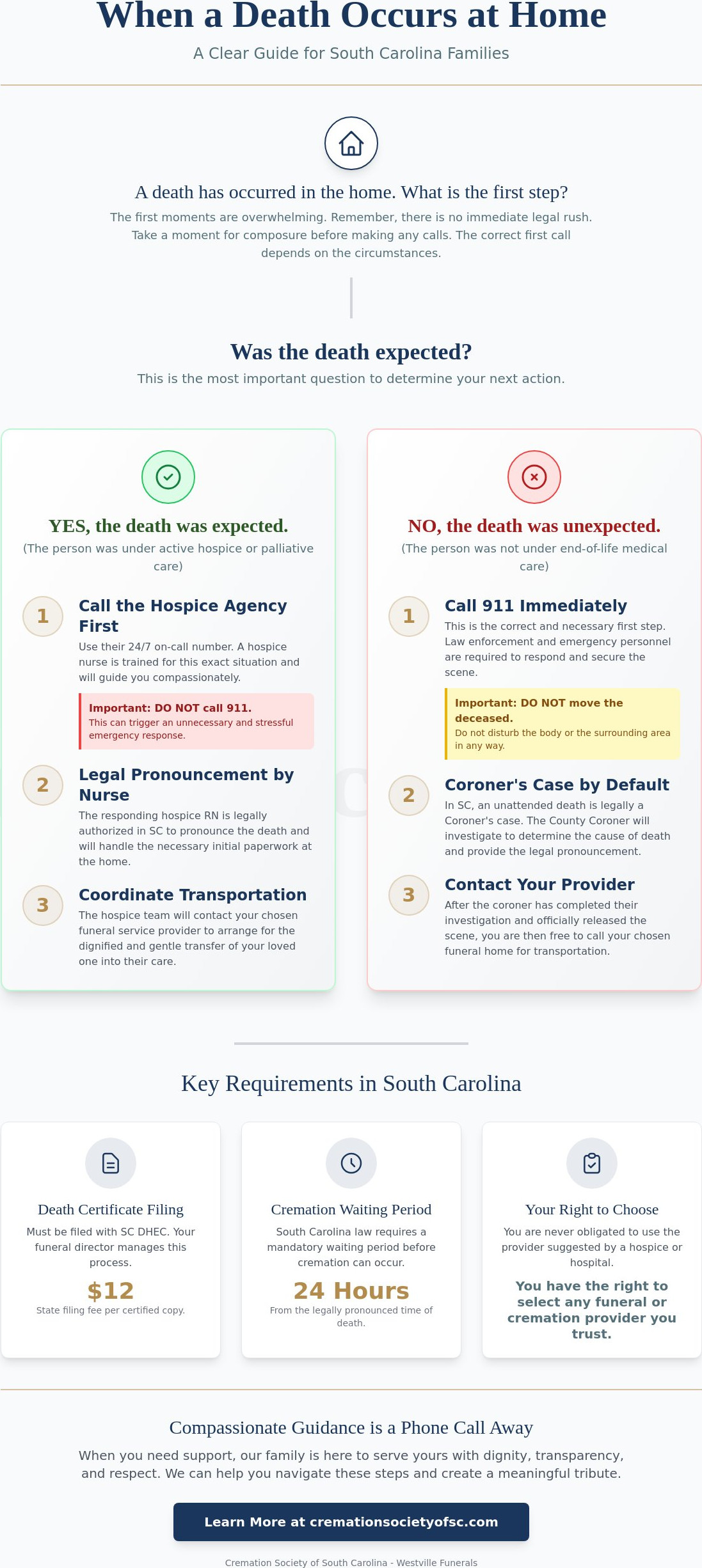
If your loved one was under active hospice or palliative care, your first call should be to their hospice agency. Most agencies provide a 24-hour line for families. An on-call nurse will be dispatched to your home to perform the legal determination of death. This professional will handle the immediate medical paperwork and offer a guiding hand through the process.
Following this protocol ensures three things: tranquility, dignity, and legal compliance. You should avoid calling 911 in a hospice situation, as this may trigger unnecessary police and emergency medical intervention. These responders are trained for life-saving measures, not end-of-life transitions. The hospice nurse is legally empowered to handle the pronouncement. They will typically coordinate with the funeral home you have selected to manage the transfer of care.
If the Death Was Unexpected or Unattended
When a death occurs suddenly and no medical professional is present, the protocol changes. In these cases, you must call 911 immediately. Emergency personnel and law enforcement will respond to your home to secure the scene and verify the situation. An unexpected home death is legally considered a Coroner’s case by default in South Carolina. This does not imply wrongdoing; it is simply the state’s method of ensuring every death is documented accurately.
- Do not move the deceased or disturb the surrounding area.
- Keep medical records or current medications nearby for the coroner.
- Be prepared to answer straightforward questions about the person's health history.
The coroner or a deputy will arrive to investigate the circumstances and provide the necessary pronouncement. While it may feel intrusive during a moment of grief, it is a necessary part of the process for what to do when someone dies at home SC. Once the coroner releases the scene, you are free to contact your chosen provider for transportation and care. Avoid moving the body until the authorities or medical professionals give you specific permission to do so.
Understanding South Carolina Pronouncement Laws
Legal death in South Carolina is a specific designation. It's guided by South Carolina Code Section 44-43-140. This law defines the criteria medical professionals must use to determine when life has ended. One of the most common points of confusion for families is the recorded time of death. Legally, the time of death is the moment a licensed professional pronounces it, not necessarily the moment you discovered your loved one. This distinction is critical for legal documentation and estate processing. It ensures that the timeline of events is recorded with medical and legal precision.
Who is Legally Authorized to Pronounce Death in SC?
In South Carolina, several licensed professionals have the authority to pronounce death. This includes physicians, Physician Assistants (PAs), and Advanced Practice Registered Nurses (APRNs). If your loved one was under hospice care, a Registered Nurse (RN) is legally empowered to pronounce death and sign the necessary paperwork within the home setting. This allows for a more tranquil transition without the need for emergency services. For unattended deaths, the County Coroner or a Deputy Coroner must be the one to provide the official pronouncement. Understanding these roles helps clarify what to do when someone dies at home SC while keeping the process orderly. You can find more details on these regulations in the South Carolina Home Funeral Laws. These rules apply whether the death was expected or sudden.
The Role of the County Coroner in the Upstate
Coroners in Upstate counties like Greenville, Spartanburg, and Anderson serve as the legal guardians of the deceased's physical remains. They investigate any death that is non-natural, sudden, or occurs without a physician present. Their primary job is to determine the cause and manner of death. They may require an autopsy if the cause isn't immediately clear. A funeral home cannot legally transport your loved one until the Coroner has officially released the body. This step ensures all legal standards are met before moving toward final arrangements. Additionally, South Carolina law requires a 24-hour waiting period after death before any cremation can take place. For families seeking a simple, dignified path forward, exploring affordable cremation options can provide peace of mind once the legal requirements are satisfied. The coroner's office acts as a bridge between the home and the care provider.
As of May 2026, the South Carolina Department of Public Health (DPH), formerly DHEC, has streamlined the filing process. Most documentation is now handled through digital filing systems by your chosen provider. This modernization reduces the administrative burden on grieving families. It ensures that the five-day filing deadline is met efficiently and accurately. Following these legal steps correctly is a core part of what to do when someone dies at home SC to prevent future delays. It helps the family move from legal requirements to personal remembrance.
Coordinating Transportation and Care of the Body
Once the legal pronouncement is complete, the focus shifts to physical care. You have the absolute right to choose any funeral home or cremation society in South Carolina. You aren't obligated to use a specific provider just because they've worked with your hospice agency or local hospital before. This choice is yours. It’s a moment to select a partner who aligns with your values and your budget. Before any transportation can occur, the staff will confirm the 'release' status from the attending nurse or the county coroner. This verification is a legal safeguard for your family and the provider. It ensures that every requirement for what to do when someone dies at home SC has been met before the transfer begins.
Grief doesn't follow a schedule. Many families feel a sudden rush to have their loved one moved, while others need time to sit in the stillness. It’s perfectly acceptable to request a few private moments of goodbye before the removal team arrives. Most providers in the Upstate area, including Greenville, Spartanburg, and Anderson, will arrive at your home within one to three hours of your call. Use this time to gather your thoughts, notify close relatives, or simply be present. This period of reflection can be a vital part of finding composure during a high-stress situation.
Contacting a Funeral Home or Cremation Society
When you make the call, have a few pieces of information ready. The coordinator will ask for the deceased’s full legal name, the exact home address, and the name of the official who performed the pronouncement. They'll also ask about any immediate-need fees for transportation or professional services. For those seeking transparency and straightforward options, you can review simple cremation services in Greenville & Upstate SC to understand the process and costs involved. Clear communication at this stage prevents confusion later. It builds a foundation of trust and reliability between you and your chosen provider.
What Happens During the Removal Process?
Dignity is the priority during the transfer of care. The removal team will typically arrive in a discrete vehicle, such as a professional van or SUV, rather than a hearse. They use specialized equipment designed for home settings to ensure the process is quiet and respectful. This team acts as your loved one’s first stewards. They will verify all identification and legal paperwork before leaving your residence. This ensures accuracy and safety at every turn. Once the transfer is complete, your loved one is taken to a climate-controlled holding facility in the Upstate. This is an essential step in what to do when someone dies at home SC, providing a secure and respectful environment while you finalize arrangements. This professional care offers you the breathing room needed to plan the next steps of remembrance.
Managing Legal Documentation and Death Certificates
The death certificate serves as the primary legal document for closing a loved one’s estate. It acts as a master key. You'll need it to access bank accounts, settle life insurance policies, and transfer property titles. In South Carolina, the Department of Public Health (DPH), formerly known as DHEC, oversees all vital records. Handling this paperwork correctly is a fundamental part of what to do when someone dies at home SC. Most of this process is now handled through a streamlined electronic system. Your funeral director will typically file the record with the state bureau of vital statistics to ensure everything is legally compliant.
South Carolina law requires that a death certificate be filed within five days of the passing. This tight window makes efficiency crucial. By 2026, the state has fully transitioned to a digital filing system. This modernization allows medical professionals and funeral directors to collaborate instantly. It reduces the wait time for families who need to begin the probate process. Having these documents in hand provides a sense of order during a chaotic time. It allows you to move from the immediate crisis toward long-term estate management with confidence.
Information Needed for the SC Death Certificate
Accuracy is vital when gathering biographical data. Even a small typo can cause significant delays in probate court. You'll need to provide the deceased’s full legal name, Social Security Number, and their exact date and place of birth. Be prepared to provide their parents' names, including the mother’s maiden name. You'll also need to verify their veteran status, their highest level of education completed, and their primary occupation. Gathering these details in a single folder makes the intake process much smoother for everyone involved.
How to Obtain Certified Copies in the Upstate
You can order certified copies through your funeral provider or directly from local health department offices. In the Upstate, both the Greenville and Spartanburg county health departments offer in-person pickup options for those who need documents quickly. As of May 2026, a standard search costs $12 and can take up to four weeks. If you're in a hurry, an expedited search costs $17 and is usually processed in five business days or less. Additional copies ordered at the same time are $3 each. We recommend that families order at least 5 to 10 certified copies. Banks, insurance companies, and the Social Security Administration often require original documents rather than photocopies. If you have questions about the timeline, your provider can assist when requesting certified death certificates as part of your arrangements.
Moving Toward Remembrance and Final Arrangements
Once you've navigated the immediate legal and medical requirements, the atmosphere in your home begins to change. The initial shock of the crisis fades. It's replaced by the need to honor the person you lost. Knowing what to do when someone dies at home SC involves more than just certificates and transportation; it's about making choices that reflect a unique life. South Carolina families are increasingly stepping away from the rigid structures of the past. They're looking for arrangements that feel personal, modern, and environmentally conscious. This shift allows for a more authentic celebration of a loved one's legacy.
Your focus can now move toward the environmental impact of final arrangements and the specific wishes your loved one may have expressed. We see a growing preference for simplicity over spectacle. This transition is a time for reflection. It's a time to decide how you want the community to remember the life lived. Choosing a path that aligns with your family's values provides a sense of peace that logistics alone cannot offer. The Cremation Society of South Carolina specializes in making this move from logistics to legacy as peaceful as possible, ensuring every detail is handled with steady composure.
Disposition Options: Beyond Traditional Burial
Traditional ground burials remain a respected choice, but they aren't the only path available to Upstate families. Many are now exploring Aquamation in South Carolina as a gentle, water-based alternative to traditional flame cremation. This process, technically known as alkaline hydrolysis, uses water and temperature to return the body to its natural elements. It's an innovative choice that appeals to those concerned with their carbon footprint or those who prefer the idea of a water-based return to nature.
Others find comfort in the simplicity of direct cremation or the natural return of a green burial. Green burials avoid embalming chemicals and use biodegradable materials, allowing for a seamless reintegration with the earth. You might also consider the difference between a traditional viewing and a memorial service. A memorial service offers more flexibility; it can be held weeks or even months later in a location that truly mattered to your loved one. Whether you choose a scattering service in the mountains or a quiet gathering at a local park, the goal is tranquility and dignity.
Support Resources for Grieving Families
The journey through grief doesn't end when the service is over. Local support groups in Greenville, Anderson, and Spartanburg provide a space to connect with others who understand your specific experience. These communities offer a shared sense of healing that is vital for long-term emotional health. Connecting with neighbors who have walked a similar path can demystify the grieving process and provide a reliable safety net during difficult days.
Online grief resources and 24/7 assistance from our team ensure that help is always within reach. We understand that questions often arise at 3 AM, long after the initial steps of what to do when someone dies at home SC are complete. Our role is to provide physical and emotional stewardship throughout the entire process. You can rely on our steady hand to guide you through every stage of this transition with honesty and respect.
Finding Peace Through Preparation and Support
Navigating the legal and emotional steps of what to do when someone dies at home SC requires a steady hand and clear information. You now understand the importance of a professional pronouncement, the 24-hour waiting period required before cremation, and the necessity of filing vital records with the state. These steps ensure your loved one is cared for with the dignity they deserve. By moving through this roadmap, you've replaced initial confusion with a sense of grounded composure. You can now focus on the personal aspects of honoring a life well-lived.
We are here to provide that guiding hand whenever you need it. As a locally owned and operated extension of Westville Funerals, we take pride in serving our Upstate neighbors with integrity and transparency. Whether you're interested in traditional services or our specialized, eco-friendly Aquamation, we offer affordable solutions tailored to your family's needs. You can contact the Cremation Society of South Carolina for immediate 24/7 assistance across Greenville, Spartanburg, and Anderson. We're ready to help you transition from the burden of logistics to the beauty of remembrance. You don't have to walk this path alone.
Frequently Asked Questions
Do I have to call the police if someone dies at home in South Carolina?
You only need to call the police if the death was sudden, unexpected, or occurred without a medical professional present. If your loved one was under hospice care, you should contact the hospice agency first rather than the police. When a death is unattended, calling 911 will trigger a response from law enforcement to secure the scene and ensure all legal protocols are followed from the start.
How long can a body stay at home after death in SC?
There is no specific state law that mandates a body must be removed within a certain number of minutes. Most families in the Upstate wait between one and three hours before the funeral home arrives for transportation. This window provides a necessary time for private goodbyes and reflection. It's best to coordinate professional care within a few hours to maintain the dignity of your loved one and ensure a smooth transition.
Who is responsible for calling the coroner in an unattended death?
The 911 dispatcher or the responding emergency personnel will typically notify the county coroner during an unattended death. If you find yourself in this situation, your only immediate responsibility is to call 911. The responding officers will then coordinate with the coroner's office to handle the legal pronouncement. This ensures every requirement for what to do when someone dies at home SC is met with professional accuracy.
Can a hospice nurse sign a death certificate in South Carolina?
A hospice nurse can legally pronounce death, but the actual death certificate is usually signed by a physician, Physician Assistant, or Advanced Practice Registered Nurse. The nurse handles the immediate medical documentation and coordinates with the doctor to ensure the filing is accurate. This professional teamwork streamlines the process for the family and prevents administrative delays during the probate process.
What is the difference between a natural and an unattended death for legal purposes?
A natural death occurs when a person dies from a known disease or old age while under a physician’s care. An unattended death happens suddenly or when no medical professional has seen the deceased within a specific timeframe. Unattended deaths automatically become coroner’s cases to rule out external factors and verify the cause of death. This legal distinction ensures that every death in the community is documented with transparency and medical integrity.
How much does it cost to have a funeral home pick up a body from a house in the Upstate?
Transportation costs vary depending on the provider and the distance traveled within Greenville, Spartanburg, or Anderson counties. Most families find that these fees are included in a standard direct cremation or burial package. We recommend asking for a General Price List (GPL) to see a transparent breakdown of professional service fees. This ensures you understand the costs upfront without any hidden surprises during a high-stress moment.
Do I need to call 911 if my loved one was in hospice care?
You don't need to call 911 if your loved one was under active hospice care at the time of their passing. Calling 911 may trigger a full emergency response, including sirens and police presence, which is often unnecessary for an expected death. Instead, call the hospice agency's 24-hour line. Their on-call nurse will arrive to handle the pronouncement and guide you through the next steps with steady composure.
What happens if I can't reach the doctor to sign the death certificate?
Your funeral director or the county coroner will step in to facilitate the signature if the primary physician is unavailable. South Carolina law requires a certificate to be filed within five days, so these professionals work quickly to secure the necessary medical certification. This coordination is a standard part of what to do when someone dies at home SC. It prevents you from having to manage medical bureaucracy while you are focused on remembrance.

Article by
Ian Nelms
Ian Nelms has worked in the funeral and cemetery profession since 1991, beginning his career in Beaumont, Texas. Over the past three decades, he has been involved in all aspects of the death care industry—including operations, acquisitions, preneed development, crematory management, and the leadership of multi-location funeral home and cemetery organizations.
His experience across a wide range of service models provides a practical understanding of the decisions individuals and families face, along with the importance of clarity, simplicity, and value. His work today is focused on industry strategy, operational development, and improving how funeral service providers communicate and deliver options in a modern environment.
In addition to his work in funeral service, Ian is actively engaged in technology, marketing, and artificial intelligence. He applies AI systems, prompt engineering, and digital strategy to enhance how information is shared, how services are presented, and how organizations better serve their communities. He is also the founder of Memorial Flight Systems, a drone operations company focused on aerial services and emerging applications.
Earlier in his career, Ian navigated a legal matter related to a business transaction that was resolved. That experience shaped his commitment to accountability, transparency, and disciplined operations. Since then, he has continued to build, advise, and operate businesses with a focus on long-term trust and performance.
He writes to provide practical, straightforward insight for readers seeking clear information about funeral service and end-of-life options across Greenville, Spartanburg, Anderson, and the surrounding areas of Upstate South Carolina.
Disclaimer
Content provided by Ian Nelms is for informational and educational purposes only and does not constitute funeral directing, arrangement services, or licensed preneed advice. Laws and regulations vary by state; for assistance, please contact Cremation Society of SC–Westville Funerals or a licensed funeral professional in your area for more information.