Did you know that one traditional flame cremation produces 535 pounds of CO2, which is the equivalent of a 609-mile car journey? For many South Carolina families, the heat and intensity of fire can feel unsettling. You might find yourself searching for a more tranquil way to honor a loved one while protecting the environment they cherished. It's common to feel overwhelmed by the technical details and local regulations when you're simply looking for a dignified farewell.
We believe that clarity brings comfort. This guide offers a transparent look at aquamation vs flame cremation pros and cons to help you make an informed choice for your family in 2026. You'll learn about the gentle nature of alkaline hydrolysis, which uses 90% less energy than fire and returns approximately 20% more remains to your care. We'll also cover the specific legal requirements in South Carolina and the physical differences in the ashes you'll receive. Our goal is to provide the steady composure you need to choose a path of peace, remembrance, and environmental stewardship.
In This 2026 Guide:
- Understand the environmental benefits of alkaline hydrolysis: it uses 90% less energy, produces no harmful emissions, and significantly lowers your carbon footprint.
- Discover the physical differences in the remains you'll receive, including why water cremation preserves 20% more of your loved one's bone minerals.
- Weigh the aquamation vs flame cremation pros and cons to find the best fit for your family's values, budget, and peace of mind.
- Verify the legal landscape in South Carolina, including the 24-hour waiting period and the availability of modern disposition methods in your community.
Understanding the Modern Choice: Aquamation vs. Flame Cremation
South Carolina families are changing how they think about final goodbyes. In the past, traditional ground burial was the standard. Today, more families in Greenville and Spartanburg are seeking options that reflect their values of environmental stewardship and gentle care. This shift has led to a deeper interest in "disposition," a term we use to describe the final method of returning a loved one to the earth. When you weigh the aquamation vs flame cremation pros and cons, you're looking at two distinct paths. One is powered by thermal energy. The other is powered by chemical energy.
Choosing between fire and water is a personal decision. It often involves balancing long-standing family traditions with a desire for a smaller ecological footprint. We're seeing a growing demand for transparency in this process. Families want to understand exactly what happens to their loved ones and what the physical results will be. By demystifying these modern alternatives, we provide the steady composure needed to navigate a difficult time with confidence and peace of mind.
What is Traditional Flame Cremation?
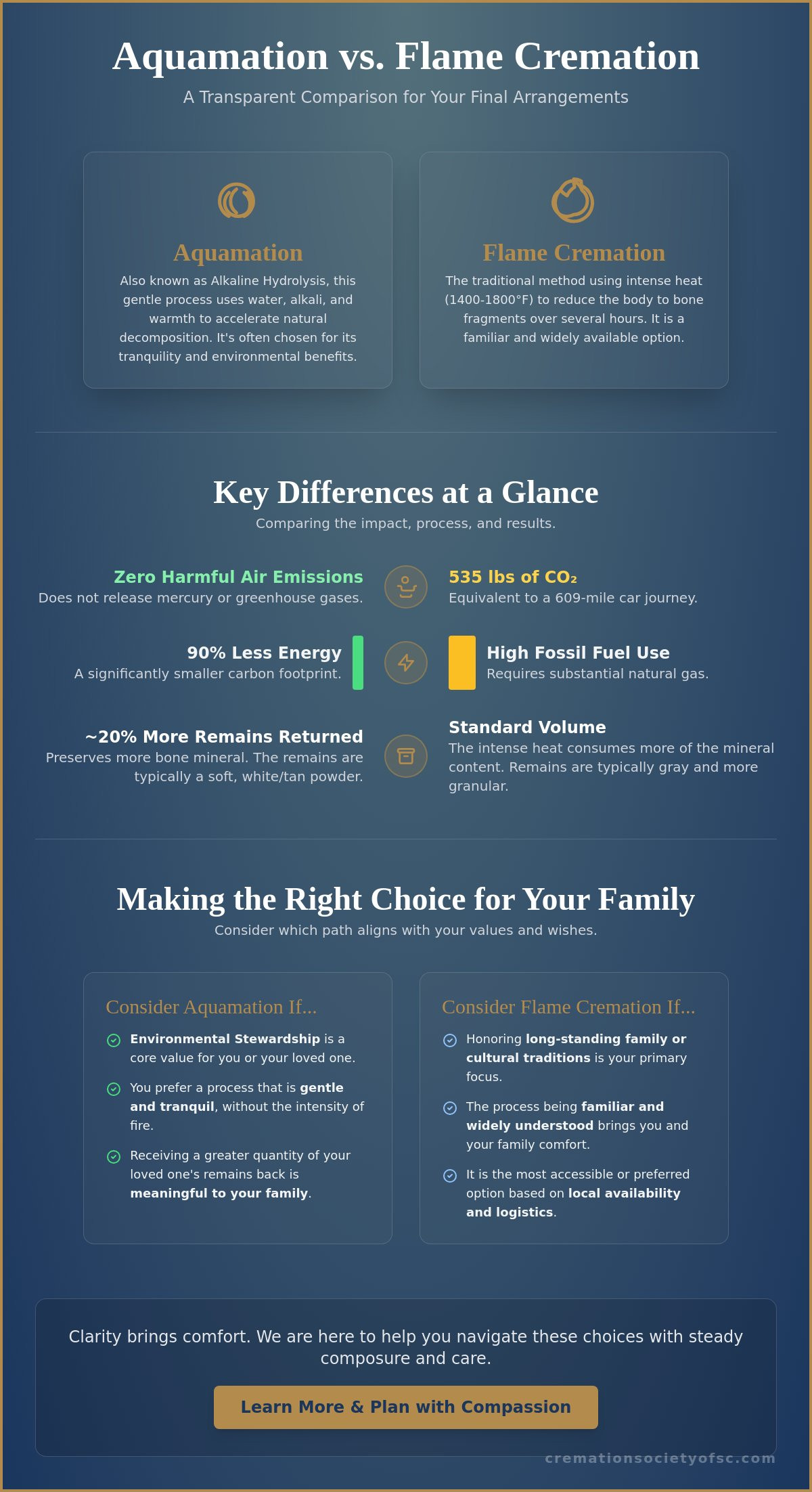
Traditional flame cremation uses intense heat to accelerate the natural transition of the body. The process occurs in a specialized chamber where temperatures reach between 1400°F and 1800°F. Over a period of two to three hours, the heat reduces the remains to bone fragments. Once the chamber cools, these fragments are carefully processed into the fine, gray granules most people recognize as ashes. It remains the most common choice because of its widespread availability and the familiarity it offers to grieving families. It provides a reliable, efficient way to handle logistics while allowing for various memorial service options.
What is Aquamation (Alkaline Hydrolysis)?
Aquamation, scientifically known as alkaline hydrolysis (aquamation), offers a water-based alternative. Instead of fire, this method uses a combination of gentle water flow, moderate temperature, and a small amount of alkaline minerals. This process mirrors the natural decomposition that occurs in a traditional burial, but it's completed in a matter of hours rather than years. Many families describe this as a "gentle" return to nature. You might hear it called bio-cremation, green cremation, or water cremation. It appeals to those who feel uneasy about the intensity of fire. By choosing water, families find a sense of tranquility and dignity in the transition. Understanding the aquamation vs flame cremation pros and cons starts with recognizing these two very different physical experiences. One relies on the power of fire. The other relies on the grace of water. Both lead to a place of remembrance, but the journey there is fundamentally different.
Comparing the Environmental Impact and 'Gentleness'
Choosing a final path is about more than logistics. It's about the legacy we leave in the South Carolina soil and air. When evaluating aquamation vs flame cremation pros and cons, the environmental data is stark and deserves a transparent look. Traditional flame cremation relies on a heavy consumption of natural gas. A single process releases approximately 535 pounds of carbon dioxide into our atmosphere. That's equivalent to driving a car 609 miles. For families in Greenville and Spartanburg, these numbers represent a significant footprint on the land we love and the air our children breathe.
We see a growing number of families who want their final act to be one of protection for the environment. They're looking for ways to reduce their carbon footprint even in death. This isn't just about being "green." It's about a practical, grounded approach to stewardship. By choosing a method that uses fewer resources, you're making a statement about what matters to you. You're ensuring that your loved one’s transition doesn't come at a high cost to the Upstate's natural beauty. It's a way to align a life lived with integrity with a final departure that honors those same values.
Energy Consumption and Carbon Footprint
Traditional retorts use intense fossil fuel to maintain extreme heat. This releases CO2 and trace mercury vapor from dental amalgams. In contrast, aquamation utilizes electricity and a water-based solution. According to the Cremation Association of North America, this method uses 90% less energy than flame-based systems. It eliminates direct greenhouse gas emissions entirely. This efficiency allows families to prioritize stewardship while maintaining the dignity of the service.
The technical shift from fire to water is significant. Natural gas retorts operate by burning fuel at high intensity for several hours. This doesn't just consume resources; it creates byproducts like nitrogen oxides. Aquamation bypasses this entire combustion cycle. It uses a solution of 95% water and 5% alkaline minerals. This mixture flows gently over the remains, mimicking the natural decomposition that would take years in a traditional grave. By utilizing this method, you're choosing a path that keeps the air in our community cleaner for future generations.
The Emotional Appeal of a Water-Based Process
Fear of fire is a common and natural response. For many, a water-based return to nature feels more compassionate. It’s a quiet, tranquil cycle. There is no roar of a burner or the harshness of extreme heat. Instead, there is a steady, respectful transition. This narrative of "gentleness" reflects the physical reality of the process. It allows families to focus on remembrance rather than the mechanics of loss.
Validating your feelings is a core part of our mission as your neighbor. We understand that the "violence" of fire can be an obstacle to peace of mind. For many, the idea of a water-based process feels like a more compassionate end. It offers a sense of calm to those left behind. When you weigh aquamation vs flame cremation pros and cons, consider which method best reflects the personality of your loved one. Did they find peace by the water? Did they strive to protect the natural world? If you're looking for a more sustainable path, you might explore our cremation and burial services to find the right fit. We are here to guide you toward a choice that feels right for your heart.
Pros and Cons of Aquamation vs. Flame Cremation
Choosing a method of disposition is a decision that balances time, budget, and personal beliefs. While both paths lead to a respectful conclusion, the logistical realities differ significantly. When analyzing aquamation vs flame cremation pros and cons, families often start with accessibility. Flame cremation is available at nearly every funeral provider in South Carolina. Aquamation, however, requires specialized equipment that is currently less common. Cremation Society of South Carolina - Westville Funerals is proud to be among the few providers in the Upstate offering this water-based alternative. This ensures that modern choice is within reach for our neighbors in Greenville and Seneca.
The timeline of each process also plays a role in planning. Fire cremation is relatively quick, typically taking 2 to 3 hours. Water cremation is a slower, more deliberate cycle that lasts between 6 and 18 hours. This difference rarely affects the timing of a memorial service, but it's a detail many families find helpful to know. According to the Cremation Association of North America's Guide to Alkaline Hydrolysis, this extended time allows for a gentle molecular breakdown that preserves more of the physical remains.
The cost factor is another common point of confusion. Many assume that newer technology automatically comes with a prohibitive price tag. In 2026, the gap between these two options has narrowed. While aquamation may have a slightly higher starting point than basic flame cremation, it remains significantly more affordable than a traditional full-service burial. Cremation Society of South Carolina - Westville Funerals believes in total financial transparency. Clarity regarding costs is a form of compassion. It allows you to focus on remembrance, healing, and peace.
Advantages and Disadvantages of Flame Cremation
- Pro: Universal Availability. You can find flame cremation services easily throughout Greenville and Spartanburg.
- Pro: Immediate Efficiency. The faster cycle allows for quicker processing if a family has urgent travel needs.
- Con: Environmental Cost. The reliance on fossil fuels remains a significant drawback for eco-conscious families.
- Con: Physical Result. High heat can result in "charred" bone fragments, which some find less comforting than the alternative.
Advantages and Disadvantages of Aquamation
- Pro: More Remains Returned. Families receive approximately 20% more remains compared to fire. This occurs because the water process preserves bone minerals often lost to the draft of a flame retort.
- Pro: DNA Preservation. Because there is no combustion, the molecular transition is more natural. It's a purely gentle breakdown.
- Con: Scarcity of Providers. Finding a local facility that offers this technology is still a challenge in many parts of the state.
- Con: Deliberate Pace. The 6 to 18 hour cycle requires more time than a traditional flame-based process.
What to Expect: Remains, Urns, and Memorialization
The final physical return of a loved one is a moment of profound significance. Many families don't realize that the choice between fire and water fundamentally changes the appearance and volume of the remains they receive. When you're weighing aquamation vs flame cremation pros and cons, it's helpful to look past the process and consider the tangible result you'll hold in your hands. Both methods result in sterile bone minerals, but the energy used creates two very different textures. Understanding these differences ensures there are no surprises during your time of remembrance.
We believe that transparency regarding these physical results provides a sense of steady composure. You deserve to know exactly what to expect when you receive an urn. Whether you choose the traditional path or the modern water-based alternative, the remains are handled with the highest level of dignity and stewardship. Our goal is to ensure you feel prepared for the next steps of memorialization, whether that involves a local scattering or a private place of honor in your home.
Comparing the Appearance and Volume of Ashes
Traditional flame cremation results in remains that most people describe as "ashes." These are typically coarse and gray in color. They often contain varied textures and small fragments of carbon "char" left behind by the combustion process. Because the high-velocity air in a flame retort can carry away fine particles, the total volume is slightly less than what the body naturally provides. It's a familiar result that many find traditional and respectful.
In contrast, aquamation produces a fine, white powder that looks similar to ivory sand. This is pure calcium phosphate, free from carbon discoloration or charred fragments. As we noted earlier, this process preserves approximately 20% more remains because it doesn't utilize high-heat air currents. The result is a consistent, soft texture that many families find comforting to touch or scatter. Both types of remains are completely sterile and safe for handling, but the visual difference is striking when placed side-by-side.
Urn Selection and Scattering in South Carolina
Most standard urns are designed to hold the remains of an average adult. However, because aquamation results in a higher volume of minerals, you may need to select a slightly larger vessel. We recommend checking the cubic inch capacity of any urn before making a final purchase to ensure a proper fit. If you're looking for a way to keep a small portion of these fine remains close to you, Keepsake Jewelry offers a discreet and beautiful way to maintain that connection.
The finer consistency of water-based remains also changes the experience of scattering in our local landscape. If you're planning a memorial at Table Rock or Lake Keowee, the fine powder will drift more easily on the Blue Ridge mountain breeze. The heavier, varied texture of fire-based ashes tends to fall more directly to the earth or water. This is an important detail for families who envision a specific "drift" during a scattering ceremony. If you're ready to explore these options further, view our personalized memorial services to see how we can help you honor your loved one's unique legacy.
Deciding What’s Right for Your Family in South Carolina
Choosing a path for a loved one is a deeply personal task. We've compared the science, the environmental footprint, and the physical results of both methods. Now, the final step involves looking at your family's specific needs. When you weigh the aquamation vs flame cremation pros and cons, you're making a choice that reflects a lifetime of values. We respect every family's decision, whether it's rooted in traditional customs or a desire for modern stewardship.
Is Aquamation Legal and Available in Upstate SC?
Families often ask about the legal standing of newer technologies. We can confirm that alkaline hydrolysis is fully legal in South Carolina. The SC Board of Funeral Service regulates this process with the same oversight as any other method. While some providers are still adapting, Cremation Society of South Carolina - Westville Funerals has already integrated this technology. Our facilities in Greenville and Seneca serve families from Spartanburg to Clemson. This ensures that a gentle, water-based choice is a local reality, not just a distant concept.
How Cremation Society of South Carolina - Westville Funerals Simplifies the Decision
We believe that making an informed choice shouldn't be stressful. Our commitment to Simple Cremation Services provides the framework for a dignified farewell. We offer transparent pricing for both fire and water options, ensuring your budget is respected. There are no hidden fees or complex sales tactics. By providing all the aquamation vs flame cremation pros and cons upfront, we empower you to choose with confidence. Our approach is always built on three pillars: Compassionate, Affordable, Simple.
Our team acts as a supportive ally during your most difficult moments. We combine modern innovation with traditional values of service. This balance allows us to handle the logistics with efficiency while providing the emotional support you need. If you're ready to discuss these options, we're here to listen. We provide the steady composure and local expertise required to honor your loved one's unique story properly.
Honoring Your Loved One with Confidence and Clarity
Choosing a final path is a significant act of stewardship and love. We have explored how water cremation offers a gentle, eco-friendly return to nature while traditional fire remains a reliable, efficient standard. Understanding the aquamation vs flame cremation pros and cons allows you to move forward with peace of mind. You now know what to expect regarding the physical remains, the environmental impact, and the legal landscape here in South Carolina.
Our team has served the Upstate for decades as a locally owned and operated partnership. We provide 24/7 immediate assistance to ensure you never have to navigate these choices alone. Whether you prioritize the tranquility of water or the familiarity of fire, we offer a guiding hand rooted in integrity. We invite you to compare our fire and water cremation packages today to find the right fit for your family's values and budget. Our mission remains constant: to provide a process that is compassionate, affordable, and simple. You deserve a farewell that reflects the unique life being honored and the legacy they leave behind.
Frequently Asked Questions
Is aquamation legal in South Carolina?
Yes, aquamation is fully legal in South Carolina and is regulated by the South Carolina Board of Funeral Service. Families across the Upstate can choose this method with the same legal standing as traditional burial or fire cremation. Our facilities follow all state guidelines to ensure a dignified and lawful process for every family we serve.
How much does aquamation cost compared to fire cremation?
Aquamation typically carries a higher initial cost than basic flame cremation due to the specialized technology and the longer time required for the process. However, it remains a significantly more affordable option than a traditional full service burial. We maintain a policy of transparent pricing to help you understand the value of each method without any hidden fees.
What happens to the water used in the aquamation process?
The sterile liquid byproduct is safely returned to the ecosystem through the local wastewater treatment system. This solution contains no DNA and consists of organic compounds like salts, sugars, and amino acids. It is a completely sterile, aqueous solution that meets all local environmental regulations and represents a clean return to the natural water cycle.
Can we still have a traditional funeral service with water cremation?
Yes, you can pair a traditional memorial service or visitation with water cremation. Choosing a water-based process does not limit your options for gathering and remembrance. We offer personalized services and live-streaming to ensure your family can honor your loved one's legacy in a way that feels familiar and respectful to your specific traditions.
Do you get more 'ashes' back with aquamation?
Yes, families typically receive approximately 20% more remains when they choose water cremation over fire. This occurs because the gentle flow of water preserves bone minerals that are often lost in the high-heat draft of a flame retort. When evaluating aquamation vs flame cremation pros and cons, the increased volume of remains is a meaningful factor for many families.
Is aquamation considered a 'green' or eco-friendly burial alternative?
Aquamation is recognized as one of the most eco-friendly disposition methods available today. It uses 90% less energy than flame-based systems and produces zero direct greenhouse gas emissions. This makes it an ideal choice for those who lived their lives with a commitment to environmental stewardship and want their final act to protect the South Carolina landscape.
Can I pre-plan for aquamation even if I'm not ready for services yet?
Yes, you can pre-plan and pre-authorize your choice of aquamation at any time. Documenting your wishes now provides your family with a clear guiding hand and ensures your preferences are honored. Pre-planning allows you to carefully weigh the aquamation vs flame cremation pros and cons today so your loved ones don't have to make those decisions during a time of high stress.
Does the Catholic Church or other religions accept water cremation?
Religious acceptance of alkaline hydrolysis varies by denomination and individual congregational leadership. While many faiths that accept flame cremation also view water cremation as a dignified option, others are still evaluating the process. We recommend speaking with your local clergy or spiritual advisor to understand how this modern, gentle method aligns with your specific religious requirements and family traditions.

Article by
Ian Nelms
Ian Nelms has worked in the funeral and cemetery profession since 1991, beginning his career in Beaumont, Texas. Over the past three decades, he has been involved in all aspects of the death care industry—including operations, acquisitions, preneed development, crematory management, and the leadership of multi-location funeral home and cemetery organizations.
His experience across a wide range of service models provides a practical understanding of the decisions individuals and families face, along with the importance of clarity, simplicity, and value. His work today is focused on industry strategy, operational development, and improving how funeral service providers communicate and deliver options in a modern environment.
In addition to his work in funeral service, Ian is actively engaged in technology, marketing, and artificial intelligence. He applies AI systems, prompt engineering, and digital strategy to enhance how information is shared, how services are presented, and how organizations better serve their communities. He is also the founder of Memorial Flight Systems, a drone operations company focused on aerial services and emerging applications.
Earlier in his career, Ian navigated a legal matter related to a business transaction that was resolved. That experience shaped his commitment to accountability, transparency, and disciplined operations. Since then, he has continued to build, advise, and operate businesses with a focus on long-term trust and performance.
He writes to provide practical, straightforward insight for readers seeking clear information about funeral service and end-of-life options across Greenville, Spartanburg, Anderson, and the surrounding areas of Upstate South Carolina.
Disclaimer
Content provided by Ian Nelms is for informational and educational purposes only and does not constitute funeral directing, arrangement services, or licensed preneed advice. Laws and regulations vary by state; for assistance, please contact Cremation Society of SC–Westville Funerals or a licensed funeral professional in your area for more information.