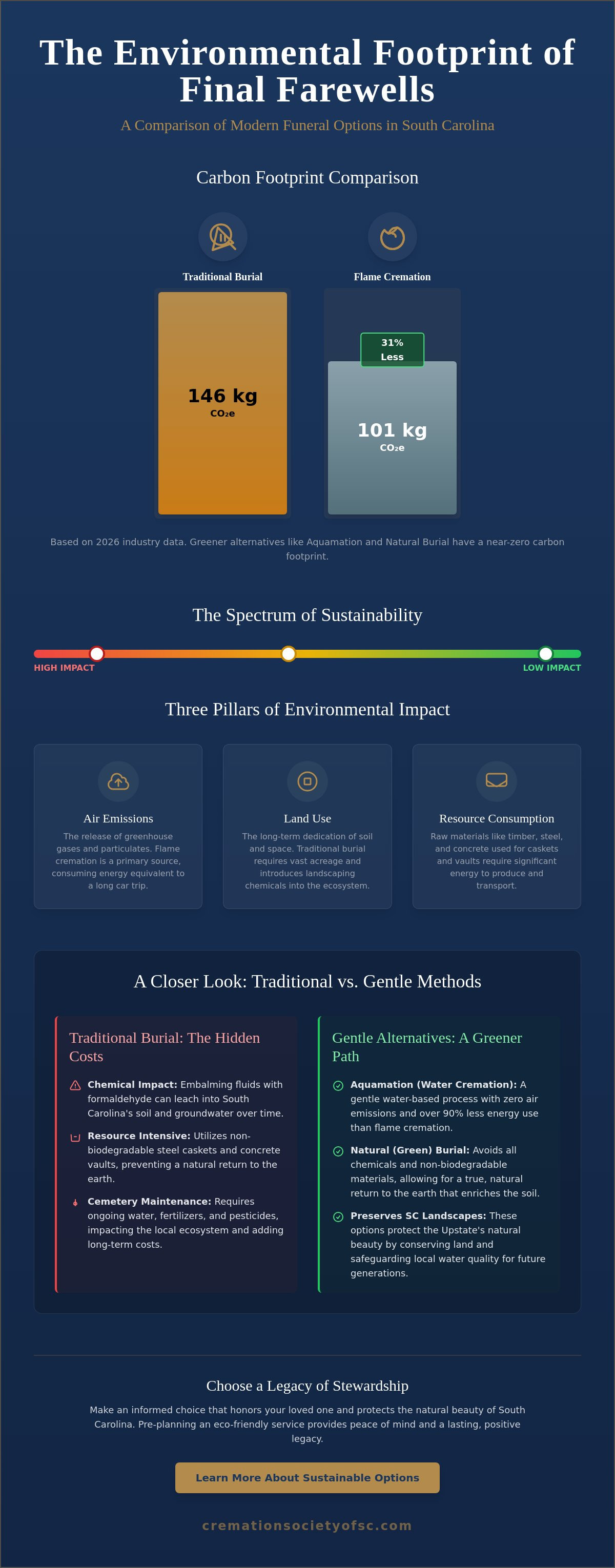
A 2026 study reveals that a single traditional burial produces 146 kg of CO2 equivalent, while a standard cremation produces 101 kg. This 31 percent difference shows that understanding the environmental impact of cremation vs burial is more complex than just picking the most popular option. Many families in the Upstate and across South Carolina want to leave a legacy of life. However, they often feel overwhelmed by conflicting claims or the fear of greenwashing in the funeral industry.
It's natural to feel a sense of responsibility toward the land we call home, especially when considering how a final rest might affect local groundwater or our delicate ecosystems. You deserve a choice that honors both your loved one and the planet without the weight of uncertainty. This guide provides a transparent look at the ecological footprint of every arrangement option, from water cremation to green burial. We'll break down CO2 emissions, explain the specific impact on South Carolina soil, and help you find a sustainable path forward with confidence.
Key Takeaways
- Gain a clear understanding of the carbon footprint associated with modern funeral practices to help you choose a path that aligns with your environmental values.
- Explore how traditional burial affects land use and groundwater in the Upstate, especially in rapidly developing areas like Greenville and Spartanburg.
- Discover the benefits of innovative, gentle alternatives like water cremation and how they compare to the environmental impact of cremation vs burial.
- Learn how to navigate industry terminology and avoid greenwashing by focusing on certified sustainable options for a meaningful legacy.
- Find practical guidance on pre-planning an eco-friendly service that provides peace of mind for your family and protection for the South Carolina landscape.
The Carbon Footprint of a Final Farewell: An Overview
In 2026, the funeral industry is undergoing a significant transformation. Families are no longer just looking at costs or traditions; they are looking at the legacy they leave behind on the earth. The environmental impact of cremation vs burial is a major factor in these modern decisions. We define the environmental impact as the total sum of carbon, chemical, and land resources used. This includes everything from the manufacturing of a casket to the fuel used in a crematory or the maintenance of a cemetery lawn. This shift in focus reflects a deeper understanding of how our final farewells ripple through the local environment long after we are gone.
Why Your Choice Matters for the Upstate Ecosystem
Our local air quality and the preservation of South Carolina's natural beauty depend on the choices we make today. Traditional methods often rely on resource-heavy materials like steel, concrete, and exotic hardwoods. These materials require significant energy to produce and transport. By shifting our perspective from "disposal" to "stewardship," we can ensure our final act is one of protection for the environment. In cities like Greenville and Spartanburg, families are increasingly choosing options that minimize chemical runoff and preserve the soil for future generations. It's a way to ensure that the Blue Ridge vistas we love remain vibrant for those who come after us. This movement toward eco-consciousness is a commitment to the health of our Upstate communities. We see this through three primary pillars of impact:
- Air Emissions: The release of greenhouse gases and particulates during the disposition process.
- Land Use: The long-term dedication of soil and space, including the impact of landscaping chemicals.
- Resource Consumption: The raw materials like timber, metal, and water used to create funeral products.
The Spectrum of Sustainability: From Traditional to Eco-Innovative
Not all methods are created equal when it comes to the planet. We can rank these choices by their immediate environmental cost. Traditional burial, with its use of embalming fluids and non-biodegradable vaults, often sits at the high end of the impact spectrum. Standard flame cremation follows, producing approximately 101 kg of CO2 equivalent per service. This is a 31 percent reduction compared to the 146 kg produced by traditional burial, according to 2026 industry data. For those seeking the lowest footprint, options like Natural burial or water cremation offer a path toward "Net Zero" goals. These modern methods focus on carbon reduction, land preservation, and chemical safety. Understanding the environmental impact of cremation vs burial allows you to make a choice that aligns with your personal ethics. It's about providing a gentle return to the earth while maintaining the dignity and respect your loved one deserves. We believe that transparency in these metrics is a form of compassion for both the living and the land.
Traditional Burial: Examining Land Use and Chemical Impact
Traditional burial is often viewed as a permanent resting place, but the physical materials involved carry a heavy ecological weight. A single traditional burial produces approximately 146 kg of CO2 equivalent. This footprint begins long before the service with the extraction of iron for steel caskets, the logging of rare hardwoods, and the energy-intensive production of concrete burial vaults. In rapidly growing areas like Greenville and Spartanburg, land is a precious resource. Dedicating thousands of acres to permanent memorial parks creates a long-term land-use challenge that modern families are starting to question. Understanding the environmental impact of cremation vs burial helps families see that a traditional plot is more than just a space; it's an assembly of non-biodegradable materials that remain in the soil indefinitely.
Embalming Fluids and Soil Health
South Carolina's unique clay-heavy soil presents specific challenges for traditional interments. Clay tends to hold moisture and can slow the natural decomposition process significantly. When embalming fluids containing formaldehyde are used, there's a risk of these chemicals eventually leaching into the local water table. Over a 50-year period, a traditional plot remains largely unchanged due to the protective nature of steel caskets and concrete vaults. This preservation prevents the body from returning to the earth. It essentially pauses the natural cycle of life while introducing synthetic chemicals into the local ecosystem.
The Environmental Cost of Cemetery Maintenance
Maintaining the pristine look of a memorial park requires constant intervention. This includes thousands of gallons of water for irrigation, the application of pesticides to keep grass uniform, and the perpetual energy consumption of lawn care equipment. For those seeking Green end-of-life options, there's a clear alternative. Green burials eliminate the need for vaults and chemicals, allowing the land to remain a natural habitat. These methods prioritize land preservation over manicured aesthetics. They offer a way to return to the earth without the heavy carbon cost of manufacturing and maintenance. If you're exploring these choices, we offer several Green Burial options designed to honor your loved one while protecting our local South Carolina ecosystem. Choosing a method that respects the soil ensures a legacy of stewardship for future generations.
Flame Cremation: Air Emissions and Energy Consumption
Flame cremation is often viewed as the middle ground of sustainability. It avoids the permanent land use and chemical leaching associated with traditional burial. However, the process relies on the combustion of fossil fuels. A single cremation cycle requires a significant amount of natural gas to reach and maintain temperatures between 1,400 and 1,800 degrees Fahrenheit. When evaluating the environmental impact of cremation vs burial, we must look at the atmosphere as well as the soil. While it saves land, it releases carbon dioxide and other gases into the air we breathe in the Upstate.
Energy Use and Fossil Fuels
The energy required for one flame cremation is roughly equivalent to a 500-mile car trip. This energy primarily comes from natural gas. Beyond carbon dioxide, the process releases nitrogen oxide and sulfur dioxide. These are standard byproducts of high-heat combustion. Another environmental challenge involves dental amalgams, which can release small amounts of mercury vapor during the process. Modern South Carolina crematories utilize advanced filtration systems to capture these particulates, reduce their output, and protect our local atmosphere. These innovations show a commitment to local air quality. They help bridge the gap for families who want a simpler farewell but remain conscious of their carbon footprint. Many people exploring green end-of-life options find that flame cremation is a practical step toward reducing their total legacy impact.
The 'Land Neutral' Argument
The primary environmental benefit of cremation is its minimal impact on land. It doesn't require a permanent concrete vault, a steel casket, or a hardwood box that will sit in the earth for centuries. This makes it a preferred choice for families in Greenville and Spartanburg who want to preserve our local landscapes. Once the process is complete, the remains are portable. You can choose to keep them in an urn, place them in a columbarium, or return them to nature through scattering. This flexibility prevents the long-term dedication of soil and the resource-heavy maintenance required by traditional cemeteries. For those looking for a streamlined and space-saving approach, simple cremation services offer a way to honor a loved one without the heavy land-use burden. It’s a choice that respects the finite nature of our South Carolina earth while providing a dignified conclusion to a life well-lived.
Aquamation and Green Burial: The Gentle Alternatives
The environmental impact of cremation vs burial often feels like a choice between two difficult extremes. One requires the high-heat combustion of fossil fuels. The other involves the long-term dedication of land and the use of synthetic chemicals. For families in Seneca and Anderson, a third path is emerging. These gentle alternatives are the fastest-growing choices in our community. They offer a way to honor a loved one while prioritizing the health of the South Carolina landscape. By focusing on biological cycles rather than industrial processes, these methods provide a peaceful return to nature that many find deeply comforting.
The Science of Alkaline Hydrolysis
Aquamation, professionally known as alkaline hydrolysis, is a water-based process that mirrors the natural decomposition that occurs after burial. It uses a combination of gentle water flow, moderate temperature, and a small amount of alkalinity to return the body to its constituent elements. One of the most significant benefits is the energy profile. Aquamation uses about 90 percent less energy than traditional flame-based cremation. Because there's no combustion, the process results in zero direct air emissions. This makes it the cleanest choice for the Upstate atmosphere. It's a quiet, dignified method that protects our local air quality while providing a gentle transition. For a more detailed breakdown of how this works, you can explore aquamation in South Carolina to see if it aligns with your family's values.
Green Burial: Honoring the Cycle of Life
Green burial offers a land-based alternative that removes the barriers between the body and the earth. In this process, the use of concrete burial vaults and formaldehyde-based embalming fluids is strictly avoided. Instead, the body is prepared with essential oils and placed in a biodegradable shroud or a wicker casket. This approach allows the body to nourish the soil directly, fostering a truly natural cycle. It's a method that preserves South Carolina's natural landscapes and woods rather than transforming them into manicured, resource-heavy parks. Green Burial is a return to traditional, non-invasive practices that support local biodiversity. It ensures that the final resting place contributes to the health of the ecosystem rather than placing a burden upon it. If you're ready to plan a legacy that protects the environment, you can view our eco-friendly service options to find the right fit for your needs.
Choosing Your Legacy: How to Decide in Upstate SC
Selecting a final path is an act of stewardship for the South Carolina land we love. While previous sections detailed the specific metrics of various methods, your ultimate decision often rests on a personal balance between land preservation and carbon reduction. Understanding the environmental impact of cremation vs burial allows you to move past the confusion of industry marketing and select a method that truly reflects your ethics. Whether you live in Greenville or Seneca, we provide the transparent data needed to make an informed choice for your family and the planet.
Balancing Tradition with Environmental Values
Talking to family about eco-friendly choices can be a sensitive process. Many people hold deep emotional ties to traditional ground burials. You can find common ground by combining a sustainable disposition method with a traditional memorial service. Options like mountain scattering by drone or personalized keepsake jewelry offer a way to honor a life while maintaining a modern, eco-conscious perspective. These choices provide comfort, dignity, and a lasting tribute. They ensure the ceremony feels familiar while the ecological footprint remains minimal.
Pre-Planning for Peace of Mind
Making these arrangements in advance ensures your wishes are followed exactly. It removes the stress of difficult decisions from your loved ones during an emotional time. It also allows you to lock in specialized services like water cremation or green burial options that may not be standard elsewhere. Cremation Society of South Carolina - Westville Funerals supports families across the Upstate in creating these sustainable legacies. Our team offers a straightforward, non-coercive approach to planning that respects both your budget and your values. Contact our team today for a compassionate consultation to begin your journey toward a meaningful and responsible farewell.
Honor Your Values with a Sustainable Legacy
Every decision made regarding a final rest leaves a mark on the Upstate landscape. We have moved through the technical details of carbon outputs and soil health, but the heart of the matter remains your personal connection to the earth. By assessing the environmental impact of cremation vs burial, you've taken a significant step toward a legacy that prioritizes the health of our South Carolina communities. Whether you choose the land-saving benefits of flame-based methods or the gentle, water-based return of aquamation, your choice supports a future where remembrance and stewardship go hand in hand.
Cremation Society of South Carolina - Westville Funerals is proud to stand as a local neighbor and authoritative expert for families in Greenville, Seneca, and across the Upstate. We offer the specialized guidance needed to navigate modern, eco-friendly alternatives with ease and transparency. Our team provides 24/7 compassionate support to ensure your final wishes are met with dignity and steady composure. Start your eco-friendly pre-planning with Cremation Society of South Carolina - Westville Funerals today. We're here to help you create a final tribute that honors both your loved one and the planet we share.
Frequently Asked Questions
Is cremation or burial better for the environment?
Cremation typically has a lower carbon footprint than traditional burial. A 2026 study shows traditional burial produces 146 kg of CO2 equivalent while cremation produces 101 kg. This represents a 31 percent reduction in carbon impact. However, burial avoids the direct air emissions associated with high-heat combustion. The overall environmental impact of cremation vs burial depends on whether you prioritize land preservation or immediate carbon reduction for the Upstate ecosystem.
What is the most eco-friendly funeral option available in South Carolina?
Aquamation and certified green burials are currently the most sustainable choices in South Carolina. Aquamation uses 90 percent less energy than flame-based methods and produces zero direct air emissions. Green burials at preserves like Ramsey Creek in Westminster allow for a natural return to the earth. These options avoid the heavy chemical and resource use found in traditional funeral practices. They offer a way to honor a loved one while protecting our local natural beauty.
Does flame cremation release mercury into the air?
Flame cremation can release mercury vapor if the deceased has dental amalgam fillings. Modern crematories in the Upstate utilize advanced filtration systems to capture these particulates before they reach the atmosphere. If air quality is your primary concern, water cremation is a cleaner alternative. It uses no fire and eliminates the risk of mercury emissions entirely. This water-based method provides peace of mind for families who are sensitive to local air quality and environmental health.
How much energy does an average cremation use compared to a traditional burial?
A single flame cremation uses enough natural gas to power a 500-mile car trip. Traditional burial energy use is less direct but includes the manufacturing of steel caskets and concrete vaults. The energy required to maintain manicured cemetery lawns also adds to the long-term footprint. Choosing a method like alkaline hydrolysis reduces energy consumption by approximately 90 percent compared to fire. This comparison helps families understand the hidden resource costs behind every final arrangement option.
Can you have a green burial in a regular South Carolina cemetery?
Most traditional cemeteries in South Carolina require a concrete or metal burial vault to prevent the ground from settling. This requirement usually prevents a true green burial. You must typically look for certified green burial sites like Greenhaven Preserve or Ramsey Creek. Some conventional cemeteries may allow a natural section, so it's best to check their specific bylaws. We can help you identify local options that align with your desire for a non-invasive resting place.
What is water cremation, and is it legal in South Carolina?
Water cremation, also known as alkaline hydrolysis or aquamation, is a gentle process that uses water and alkalinity to accelerate natural decomposition. It is fully legal in South Carolina as of 2026. This method is often preferred by families who want an eco-friendly farewell without the emissions of fire. It provides a dignified and quiet return to nature's basic elements. It's a modern solution that respects both the individual and the surrounding environment.
Do green burials cause groundwater contamination?
Green burials do not cause groundwater contamination when conducted in properly managed preserves. The process avoids formaldehyde-based embalming fluids and synthetic materials that can leach into the soil. Bodies are buried at a depth where aerobic bacteria can efficiently break down organic matter. This natural cycle nourishes the soil rather than polluting the local South Carolina water table. It is a safe and time-tested way to return to the earth without introducing harmful industrial chemicals.
How can I make a traditional funeral more environmentally friendly?
You can reduce the footprint of a traditional service by opting for a greener approach. Request a formaldehyde-free preparation or skip embalming entirely if there is no public viewing. Choose a biodegradable casket made of wicker or sustainably sourced wood. These small changes help minimize the environmental impact of cremation vs burial while still respecting family customs. It's about finding a balance that honors your loved one's memory and the health of our shared planet.

Article by
Ian Nelms
Ian Nelms has worked in the funeral and cemetery profession since 1991, beginning his career in Beaumont, Texas. Over the past three decades, he has been involved in all aspects of the death care industry—including operations, acquisitions, preneed development, crematory management, and the leadership of multi-location funeral home and cemetery organizations.
His experience across a wide range of service models provides a practical understanding of the decisions individuals and families face, along with the importance of clarity, simplicity, and value. His work today is focused on industry strategy, operational development, and improving how funeral service providers communicate and deliver options in a modern environment.
In addition to his work in funeral service, Ian is actively engaged in technology, marketing, and artificial intelligence. He applies AI systems, prompt engineering, and digital strategy to enhance how information is shared, how services are presented, and how organizations better serve their communities. He is also the founder of Memorial Flight Systems, a drone operations company focused on aerial services and emerging applications.
Earlier in his career, Ian navigated a legal matter related to a business transaction that was resolved. That experience shaped his commitment to accountability, transparency, and disciplined operations. Since then, he has continued to build, advise, and operate businesses with a focus on long-term trust and performance.
He writes to provide practical, straightforward insight for readers seeking clear information about funeral service and end-of-life options across Greenville, Spartanburg, Anderson, and the surrounding areas of Upstate South Carolina.
Disclaimer
Content provided by Ian Nelms is for informational and educational purposes only and does not constitute funeral directing, arrangement services, or licensed preneed advice. Laws and regulations vary by state; for assistance, please contact Cremation Society of SC–Westville Funerals or a licensed funeral professional in your area for more information.